“Alpha-Hunter” (2025–2026)
Quantitative research · course project at CUHK-Shenzhen, audited in 2026
Static factor models assume loadings that are linear and stationary; China's A-shares are neither. The question was whether a sequence model could keep a Transformer's predictive edge while being more stable and more legible. The pipeline runs rolling PCA over firm characteristics, feeds the factor sequence to a Transformer encoder, and then extends it into a Temporal Factor Autoencoder — the same encoder with three auxiliary objectives: reconstruction, to keep latent factors tied to observables; smoothness, for temporal stability; decorrelation, so the factors stay distinct.
The 2025 report, written with Qian Linyi and Yan Tingyu, found on the CSI 500 that a tuned TFA cut maximum drawdown by 66% against the plain Transformer while giving up 6% of Sharpe. I led the model and the ablations.
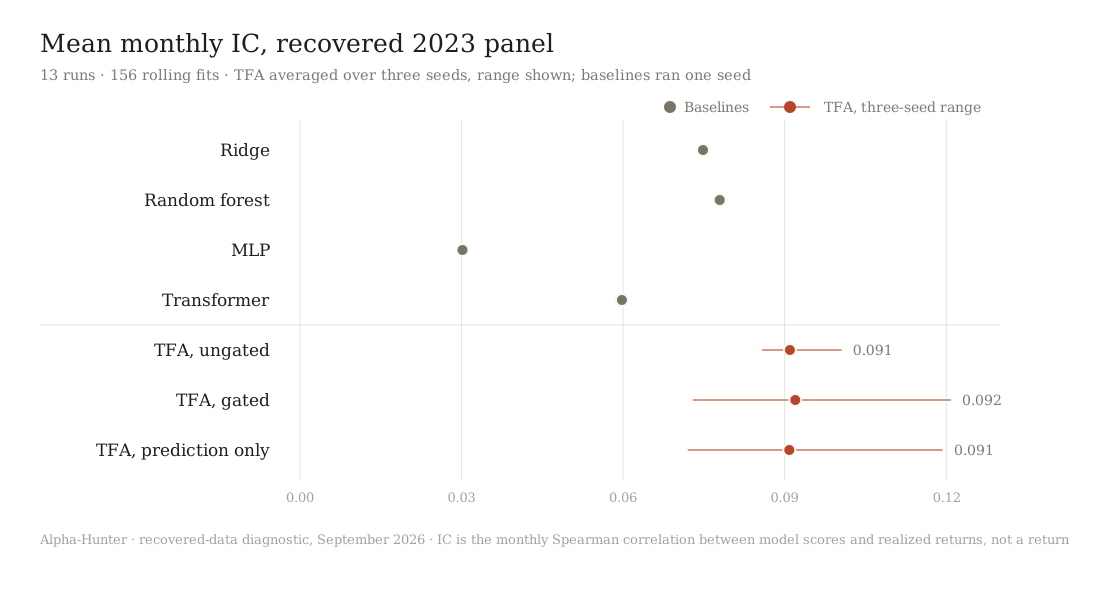
In September 2026 I went back and audited it. The published pipeline had three defects — rank targets exported as returns, overlapping training and validation dates, a wrong sequence axis. They are fixed now, under 52 regression tests and CI. On recovered 2023 data, 13 runs and 156 rolling fits later, TFA's mean monthly IC is about 0.091 against 0.075 for ridge and 0.060 for the Transformer — but the baselines ran one seed and the families differ in capacity, so that is not a ranking. The parts that were the paper's actual contribution, the gate and the auxiliary losses, add roughly +0.001 IC each, with intervals that span zero. The drawdown headline is not a validated result; the architecture is an option, not an established gain.
It stays on this page because the second half is the useful part. The result I would have liked is not the result I have, and the repository now says so in the same place it once said the opposite.